
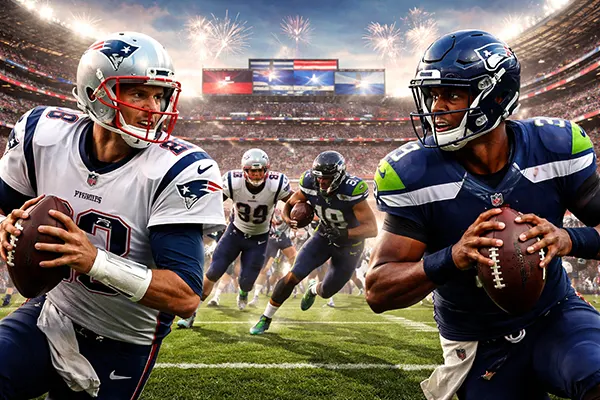
NFL: Super Bowl LX is set — Patriots vs Seahawks storylines for 8 February 2026
Super Bowl LX will be played on Sunday, 8 February 2026, at Levi’s Stadium in Santa Clara, California, with the New England Patriots representing the AFC and the Seattle Seahawks coming out of the NFC. The matchup was confirmed on Championship Sunday after New England edged Denver 10–7 and Seattle beat the Los Angeles Rams 31–27, setting up a modern rematch with very different personnel and priorities on both sidelines.
1) The matchup in one sentence: Patriots defence and game control vs Seahawks explosiveness
New England’s path to Santa Clara was built on a low-scoring, field-position kind of win in the AFC Championship, where points were scarce and mistakes mattered. That profile usually travels well to a neutral site, especially if the Patriots can keep the game slow, win special-teams moments, and turn red-zone trips into touchdowns rather than field goals.
Seattle, by contrast, arrives after a 31–27 NFC title game in which the offence produced multiple scoring drives and the defence had to deliver a defining stop late. That blend is important: it suggests the Seahawks do not need a perfect script to win — they can trade scores early and still trust their defence to close.
The most practical storyline is tempo. If the Patriots can shorten the game with sustained drives and clean situational football, they reduce the number of possessions where Seattle’s speed and big-play profile can decide the outcome in a hurry.
Trench details that will shape everything
Super Bowls are often decided by what happens on early downs. If New England can stay on schedule — four to six yards on first down, manageable third downs — it keeps their full playbook open and limits obvious passing situations where a top pass rush can tee off.
Seattle’s defensive identity has been strong enough to force “long-yardage football” on opponents, and that is where the Seahawks become most dangerous: disguised pressures, coverage rotations, and pass-rush depth all matter more when the offence must throw. If the Seahawks consistently create second-and-10 and third-and-8, the edge tilts towards Seattle.
On the other side, the Patriots’ best chance is to disrupt timing and make Seattle earn every completion. That means a disciplined rush lane (to avoid scramble damage), physical tackling on underneath throws, and a willingness to concede short gains rather than allowing broken plays to become explosive ones.
2) Quarterbacks and decision-making: where the risk really sits
Seattle reached the Super Bowl with Sam Darnold delivering three touchdown passes in the NFC Championship, including key throws that kept the Rams from turning momentum into a takeover. That performance matters because it highlights the core question: can Seattle maintain that level of efficiency against a defence designed to squeeze the middle of the field and punish indecision?
For New England, the AFC Championship win over Denver was the kind of game where the quarterback’s job is as much about avoiding disasters as it is about producing highlights. In a tight Super Bowl, that can be an advantage if the Patriots play clean and force Seattle to be perfect in the red zone.
This is also where the coaching staff will matter: pre-snap motion, protection calls, and the willingness to take calculated shots. The side that manages fourth downs, clock, and field position with fewer “free points” given away is usually the side still comfortable in the final six minutes.
Key players who can tilt the maths without dominating headlines
Seattle’s ability to turn short throws into long gains depends on separation and yards after catch. If the Seahawks consistently win one-on-one matchups on the perimeter, the Patriots will be forced into help coverages that open space elsewhere.
New England’s path is often more incremental: drive sustainability, finishing drives, and forcing punts rather than trading touchdowns. In that kind of game, running backs, tight ends, and the second receiver — not just the headline star — can decide whether a possession ends with points or with a punt from midfield.
On defence, both teams will be hunting for one high-leverage play: a strip-sack, a tipped-ball interception, a fourth-down stop. The Seahawks already showed they can live in that moment against the Rams; the Patriots showed they can win even when offence is uncomfortable, provided the defence keeps the scoreline tight.
3) Injuries, depth, and the betting market: what changed after Championship Sunday
The injury story this late in the season is less about “who is hurt” — almost everyone is — and more about who can rotate without a drop-off. Depth at offensive line, pass rush, and defensive back becomes more valuable in a Super Bowl, where fatigue and repeated matchups can expose the weakest link.
In practical terms, the two-week window is about recovery and clarity. If either team has starters carrying knocks, the key is whether they can practise enough to maintain timing, especially in the passing game and in protection communication.
The market reaction after the conference finals offered a useful snapshot of how bookmakers and bettors assessed the matchup immediately: Seattle opened as the favourite and the line moved quickly in that direction, with the spread shifting to Seahawks -4.5 and a notable move on the moneyline and total within minutes of the NFC Championship ending.
What the line movement suggests (without pretending it predicts the result)
Early movement like that usually reflects two things: perceived mismatch risks (for example, one defence that can consistently disrupt protection) and public appetite for a team that looked more explosive in the last game. It is a temperature check, not a guarantee.
It also sets up the strategic tension for New England. If Seattle is priced as the more complete team, the Patriots’ best rebuttal is a game that reduces volatility: long drives, clean special teams, and forcing Seattle to operate in the red zone rather than on explosives.
From Seattle’s perspective, the message is simpler: if they avoid the one catastrophic turnover that flips field position and emotion, their ability to score in multiple ways — and to finish with a defensive stop when needed — is exactly the blueprint that tends to win modern Super Bowls.