
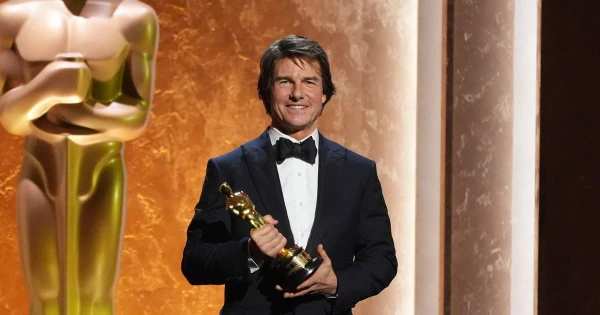
Tom Cruise to Receive AFI Life Achievement Award: Why He Was Chosen in 2026
Tom Cruise has been named the recipient of the 52nd AFI Life Achievement Award, recognising more than four decades of work that have helped shape modern cinema. The American Film Institute announced its decision on 21 October 2026, confirming that the actor and producer will receive the honour at a ceremony in Los Angeles on 24 April 2027. The announcement comes at a significant point in Cruise’s career, following his honorary Oscar in 2025 and another busy period of filmmaking. From dramatic performances that earned Academy Award nominations to action films that transformed audience expectations, his contribution extends well beyond box-office records. The AFI decision recognises not simply his fame, but his lasting influence on filmmaking, theatrical entertainment and the international film industry.
Why the American Film Institute Selected Tom Cruise
The American Film Institute confirmed that Cruise will receive its 52nd Life Achievement Award at the Dolby Theatre in Los Angeles on Saturday, 24 April 2027. The decision was made by the organisation’s Board of Trustees and announced in October 2026, several months ahead of the presentation. This distinction matters because some reports describe Cruise as the 2026 recipient, whereas the official AFI record identifies him as the 2027 honouree. The year 2026 marks the announcement, not the actual presentation. The ceremony will celebrate his career through a gala tribute, with proceeds supporting the institute’s arts and educational initiatives.
Kathleen Kennedy, chair of the AFI Board of Trustees, described Cruise as a global icon and emphasised his dedication to filmmaking. Her statement focused particularly on his work as both an actor and producer, alongside his belief that cinema can bring audiences together. This explanation reflects an important aspect of his career: Cruise has consistently supported films designed for large theatrical audiences, even as viewing habits have changed considerably. His commitment includes extensive promotional tours, involvement in production decisions and a willingness to undertake demanding physical performances. These activities have helped establish his reputation as someone whose influence reaches beyond acting alone.
The timing also reflects the scale of his achievements. Cruise turned 64 in July 2026 and has maintained a leading position in Hollywood since the early 1980s. According to AFI, films featuring the actor have generated nearly $13 billion at the worldwide box office, while his career has produced four Academy Award nominations. He has worked with major directors, appeared in acclaimed dramas and helped sustain commercially successful film series. Rather than honouring one particularly successful release, AFI is recognising a body of work that has remained influential across several generations of cinema audiences.
What the AFI Life Achievement Award Represents
Established on 23 February 1973, the AFI Life Achievement Award is the American Film Institute’s highest recognition for an individual career in film. Its purpose is to honour people whose contributions have advanced cinema and enriched American culture. The organisation considers artistic achievement, recognition from critics and professional colleagues, public appreciation and the lasting importance of a recipient’s work. These criteria distinguish the award from competitive prizes presented for individual films or performances. A successful year may contribute to an individual’s reputation, but the AFI honour concerns the broader significance of an entire career.
The award has a long history of recognising influential actors, directors and other major figures in cinema. Previous recipients include Steven Spielberg, Martin Scorsese, Denzel Washington, George Clooney, Nicole Kidman and Francis Ford Coppola. Eddie Murphy received the 51st award in April 2026, while Coppola was honoured in 2025 and Kidman in 2024. Cruise will join this group as the 52nd recipient. His selection also reflects a change introduced in 1993, when AFI expanded its criteria to include people whose careers were still active and whose future contributions could remain significant.
For Cruise, the distinction carries particular meaning because his reputation combines critical recognition with exceptional commercial longevity. Not every highly profitable actor receives major lifetime honours, just as acclaimed performers do not necessarily achieve sustained international box-office success. Cruise has managed to maintain both forms of recognition over an unusually long period. His filmography contains popular entertainment, demanding dramatic performances and collaborations with respected filmmakers. AFI’s decision acknowledges how these different parts of his career have contributed to the development and popularity of American cinema.
More Than Four Decades of Major Film Performances
Tom Cruise began building his screen career in the early 1980s, appearing in films such as Taps in 1981 and The Outsiders in 1983. His breakthrough arrived with Risky Business, also released in 1983, which established him as a leading young actor. Three years later, Top Gun transformed him into an international star. Playing naval aviator Pete Mitchell, known as Maverick, Cruise became associated with an energetic style of mainstream filmmaking built around distinctive characters and visually ambitious action. The film’s commercial success helped secure his position in Hollywood, but it also created expectations that he would repeatedly need to meet or exceed.
During the late 1980s and 1990s, Cruise demonstrated that his abilities were not limited to action and romantic leads. He appeared alongside Paul Newman in Martin Scorsese’s The Color of Money, worked with Dustin Hoffman in Rain Man and starred in Oliver Stone’s Born on the Fourth of July. The latter film earned him his first Academy Award nomination for Best Actor, after he portrayed Vietnam War veteran Ron Kovic. His performance required a substantial departure from the confident characters associated with his early popularity. It demonstrated his willingness to portray vulnerability, physical suffering and emotional conflict in a politically charged drama.
Cruise continued exploring different genres with A Few Good Men, The Firm, Interview with the Vampire and Jerry Maguire. His portrayal of sports agent Jerry Maguire brought another Best Actor Oscar nomination and became one of his most widely recognised performances. In 1999, his supporting role in Paul Thomas Anderson’s Magnolia earned a further Academy Award nomination. These projects reveal the range of filmmakers who have worked with Cruise and the different demands placed upon him. His performances have moved between courtroom drama, psychological tension, romantic comedy and complex character studies, helping explain why his career remains relevant beyond action cinema.
How Mission: Impossible and Top Gun Strengthened His Legacy
The Mission: Impossible series became one of Cruise’s most important contributions to modern commercial filmmaking. Beginning in 1996, the films combined espionage stories with increasingly elaborate action sequences. Cruise’s involvement as a producer gave him influence over the series’ creative direction, while his portrayal of Ethan Hunt provided continuity across changing directors and supporting casts. Over time, the franchise became particularly associated with practical stunt work. Rather than relying exclusively on computer-generated action, its productions frequently placed Cruise at the centre of physically demanding sequences designed to create a stronger sense of realism.
Some of the series’ most memorable moments include Cruise climbing the exterior of Dubai’s Burj Khalifa in Mission: Impossible – Ghost Protocol, hanging from an aircraft during Mission: Impossible – Rogue Nation and performing a motorcycle jump for Mission: Impossible – Dead Reckoning Part One. These sequences required extensive preparation, specialist crews and detailed safety procedures. Although the resulting scenes are designed to appear spontaneous, they depend on careful planning and cooperation between stunt professionals, camera operators and production teams. Cruise’s personal participation has become a defining feature of the films and has contributed to wider discussions about the continued importance of practical filmmaking techniques.
Top Gun: Maverick provided another major achievement when it reached cinemas in 2022, more than three decades after the original film. Directed by Joseph Kosinski, the sequel reunited audiences with Pete Mitchell while introducing a younger generation of naval aviators. Its worldwide box-office revenue exceeded $1.4 billion, making it Cruise’s highest-grossing film. The production placed considerable emphasis on aerial photography and physical performances inside military aircraft, helping create an unusually immersive flying experience. It also received six Academy Award nominations, including Best Picture, with Cruise nominated as one of its producers. The sequel demonstrated that a familiar character could remain commercially and culturally relevant when supported by a carefully developed story.

Why 2026 Became a Significant Year for Cruise’s Career
The AFI announcement followed another important milestone in Cruise’s professional recognition. In November 2025, he received an honorary Academy Award at the Governors Awards, acknowledging his exceptional contribution to cinema. This was separate from his four competitive Oscar nominations and recognised achievements accumulated throughout his career. Receiving an honorary Oscar and then being selected for the AFI Life Achievement Award within approximately a year represents a notable period of institutional recognition. Both honours reflect an assessment of his long-term influence rather than the performance of a single recent film.
His recent work has also kept him active at the centre of major film productions. Mission: Impossible – The Final Reckoning reached cinemas in 2025, continuing a franchise that has been central to his career for nearly three decades. In 2026, Cruise appeared in Digger, directed by Alejandro González Iñárritu, whose previous work includes Birdman and The Revenant. The collaboration illustrates Cruise’s continuing interest in working with established filmmakers outside his best-known action series. AFI has also identified a planned return to the character Cole Trickle in Days of Thunder 2, although a proposed project should not be treated as a completed release until its production and distribution details are formally confirmed.
There is a broader industry context to the recognition. The film business has experienced substantial changes in distribution, audience habits and production economics, particularly as streaming services have become more prominent. Cruise has remained a visible advocate for the theatrical experience, regularly supporting cinema releases and large-scale productions intended for the big screen. His career offers an example of how an established star can remain commercially relevant while adapting to changing audience expectations. The AFI honour does not imply that every film has been equally successful or critically acclaimed. Instead, it acknowledges the exceptional durability of his contribution across different phases of the industry.
What the 2027 AFI Ceremony Will Mean for His Legacy
The official presentation is scheduled for 24 April 2027 at the Dolby Theatre, a venue closely associated with Hollywood’s major awards ceremonies. AFI’s Life Achievement Award events traditionally celebrate the recipient’s career through speeches, film excerpts and appearances by fellow artists. However, the institute’s initial announcement did not establish a complete programme or confirm the individual guests who will participate in Cruise’s tribute. Those details should therefore remain separate from what has already been officially announced. The confirmed purpose of the evening is to recognise his professional achievements while raising funds for AFI’s educational and artistic activities.
The ceremony will offer an opportunity to examine how Cruise has influenced filmmaking as both a performer and a producer. His long career illustrates the importance of collaboration with directors, writers, technical specialists and fellow actors. His contributions to action cinema are particularly visible, but his dramatic performances remain essential to understanding his achievements. Films such as Born on the Fourth of July, Jerry Maguire and Magnolia demonstrate abilities that cannot be measured through ticket sales or elaborate stunts. Together with his commercial successes, these performances explain why AFI considers his work deserving of recognition alongside some of cinema’s most influential figures.
As of October 2026, Tom Cruise has been officially selected for the 52nd AFI Life Achievement Award but has not yet received it. That distinction provides the correct context for the announcement and the celebration planned for 2027. His selection recognises a career spanning more than forty years, four Academy Award nominations, major international box-office achievements and a continuing commitment to theatrical filmmaking. The honour also acknowledges his influence on how large-scale entertainment is produced and presented to audiences. Whether through dramatic character work, ambitious action sequences or his responsibilities as a producer, Cruise has helped shape several decades of Hollywood cinema, making the AFI decision a significant recognition of his place in film history.