
After Temu and Shein: How European Brands in 2026 Are Rebuilding E-commerce and Logistics for a New Type of Competition
By 2026, European retail is living with a new baseline: ultra-low prices, extreme product turnover, and cross-border parcel volumes that force even established brands to rethink how they sell and fulfil orders. Temu and Shein did not only change customer expectations around speed and price; they also pushed European brands to tighten their offer, simplify operations, and become far more intentional about where inventory sits and how returns are handled. At the same time, EU policy is moving towards stricter customs and VAT enforcement, making “cheap and frictionless import flows” harder to sustain. The brands that look strongest in 2026 are not those trying to copy ultra-fast fashion, but those building resilience through smarter fulfilment, sharper positioning, and community-driven demand.
How small and mid-sized European brands are pushing back against ultra-fast fashion
The most visible shift is strategic discipline. Many small and mid-sized European brands are reducing the number of drops per season and tightening their core assortment rather than chasing endless “newness”. Instead of competing on volume, they compete on fit, durability, materials, and consistency. This is partly commercial and partly operational: fewer SKUs means less forecasting error, fewer stock-outs, and more predictable fulfilment costs. It also reduces the hidden logistics burden that comes from keeping long-tail inventory alive across multiple locations.
In 2026, “quality-first” is not a slogan, it is an operational model. Brands are increasingly investing in product testing, clearer sizing systems, better imagery, and transparent supply-chain communication because this directly reduces returns. Return prevention has become one of the biggest levers for margin protection in Europe, where shipping and labour costs remain high and regulators are scrutinising misleading claims. A better product page and a better fit guide can be cheaper than processing thousands of avoidable returns through warehouses.
Another defensive move is shifting the customer relationship away from price-only buying. European brands are building loyalty mechanics around early access, limited runs, repair services, and member benefits. Subscriptions are also appearing in more categories than before: not only beauty and essentials, but also premium basics and kidswear bundles. This creates recurring demand that does not rely on constant discounting and gives brands a clearer demand signal for inventory planning.
Brand community, loyalty loops, and subscription economics in 2026
Community-led growth looks different in 2026 than it did five years earlier. Brands are running smaller, more targeted programmes that connect product releases with real customer groups: local ambassadors, user-generated styling content, and private member drops. The goal is to reduce paid acquisition dependence and stabilise demand. When customers return because they identify with a brand, a business can plan inventory with less guesswork and avoid the “overstock then discount” cycle that ultra-fast competitors often normalise.
Subscriptions are being used not only for revenue, but for operational predictability. A well-designed subscription model provides baseline demand that helps brands allocate stock to micro-warehouses, negotiate better carrier contracts, and schedule replenishment more efficiently. Even “soft subscription” models—where members pay a small annual fee for free delivery, priority returns, or special access—support more accurate forecasting and reduce the shock of seasonal demand swings.
For smaller brands, collaboration is also part of the community strategy. In 2026, it is increasingly common to see shared pop-up fulfilment points, joint limited collections, or co-branded campaigns between adjacent niche brands. That kind of partnership reduces marketing spend, improves conversion, and can justify local inventory positioning because demand becomes more concentrated in specific regions.
Warehouses, delivery promises, and returns: what is changing inside European fulfilment
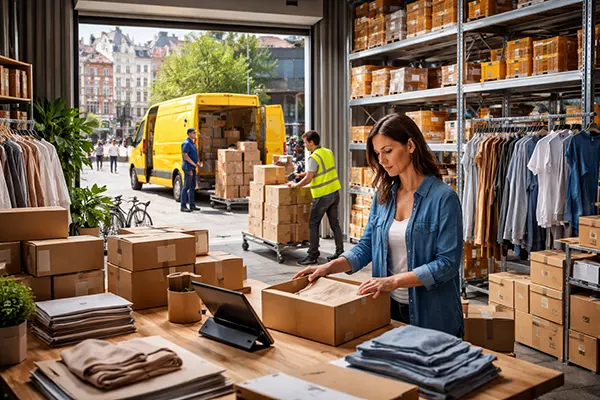
The competition triggered by Temu and Shein exposed a weakness in much of European e-commerce: too much inventory sits too far away from the customer, and returns are processed too slowly to be resold quickly. In 2026, brands are rebuilding fulfilment networks with one main goal—keep fast-moving stock closer to the buyer, and keep returnable stock circulating with minimal delay. This often means moving away from one central warehouse model towards a network approach that balances cost and speed.
Returns have become the hardest operational problem to ignore. Many European brands are investing in faster “return-to-stock” systems: automated inspection steps, clearer return reasons, resale channels, and dynamic routing that sends returns to the location where the next sale is most likely. This matters because cross-border returns are expensive and slow, and because consumer expectations now assume frictionless returns even when the purchase price is low.
Another key driver is the policy environment. The EU has publicly stated that the €150 customs duty exemption for low-value imports will be removed as of 2026, which is designed to reduce unfair competition and change how imported parcels are treated. That does not automatically solve ultra-low pricing, but it makes compliance, classification, and duty handling harder to avoid. For European brands, this change reinforces the value of having inventory inside the EU and controlling the customer experience end-to-end rather than relying on long-distance shipping flows.
Returns management as a margin strategy, not a customer-service cost
The most advanced brands in 2026 treat returns like a second supply chain. They track return reasons at product level, link them to customer segments, and feed that back into design and merchandising decisions. If a particular cut, fabric, or sizing pattern produces higher returns, they correct it early rather than accepting it as normal. This is one of the biggest differences between brands that can scale profitably and those that constantly lose margin in reverse logistics.
Operationally, brands are separating returns by condition and speed. “Fast resale” items are prioritised for quick reintegration into stock, while slower items are routed to outlet channels, recommerce partners, or secondary markets. Some brands also use local consolidation points, where returns are grouped before being shipped to a central processing hub, reducing per-parcel costs.
There is also a stronger link between returns and sustainability reporting. In Europe, brands face pressure to quantify environmental impact. Every avoided return saves transport emissions, packaging, and labour. This is why investment in better sizing tools, clearer product descriptions, and improved customer guidance is increasingly justified as both a financial and sustainability decision.
Local fulfilment, micro-warehouses, and the operational shift that defines 2026
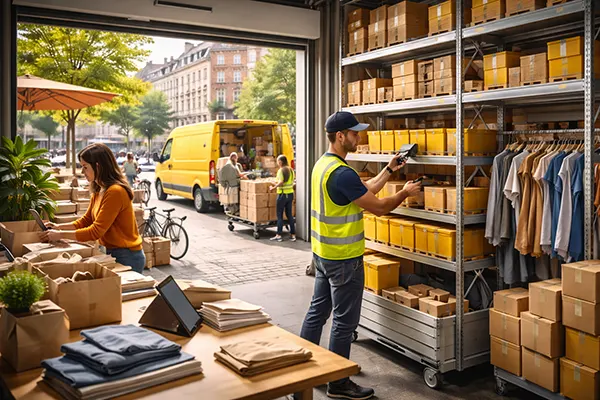
Local fulfilment has moved from “premium advantage” to baseline expectation in many European markets. Customers want short delivery windows, flexible pickup options, and reliable tracking. Brands respond by placing stock in smaller, regional nodes—micro-warehouses, urban hubs, or shared fulfilment centres—so that delivery routes are shorter and less expensive per parcel. This is particularly relevant in dense regions where same-day or next-day delivery is feasible without extreme shipping costs.
Micro-warehousing is not only about speed; it is also about risk control. In 2026, supply chain volatility has not disappeared. Brands are using regional stock to protect themselves from disruptions, carrier bottlenecks, and cross-border delays. Instead of pushing everything through one central warehouse, they can shift inventory between nodes or re-route orders when a region experiences pressure.
Another reason local fulfilment is growing is the rise of B2B fulfilment services offered by large European fashion players and logistics specialists. Brands that cannot build their own network can use fulfilment partnerships and place inventory in established EU warehouses, benefiting from faster delivery performance without building full infrastructure. This makes local inventory positioning accessible even to mid-sized labels.
Practical playbooks European brands are using to win in 2026
One of the clearest playbooks is “tight assortment, deep confidence”. Brands reduce SKU clutter, invest in a few strong categories, and focus on repeat purchase. They support this with consistent product quality and clearer customer education. The operational result is fewer fulfilment errors, fewer returns, and higher stock efficiency—advantages that low-cost mass sellers struggle to replicate without sacrificing margins.
Another playbook is “community-led demand, operational discipline”. Brands build loyalty programmes that drive predictable purchasing patterns, then use that predictability to optimise where inventory is stored. If a brand can forecast demand in a region with higher confidence, it can justify micro-warehouse placement and reduce last-mile costs, which directly improves competitiveness against ultra-low price models.
The third playbook is “hybrid fulfilment plus recommerce”. Brands combine local stock for bestsellers with recommerce channels that monetise returns and older inventory. In 2026, the best operators treat recommerce as part of the core business, not a side project. It protects margin, supports sustainability claims, and reduces dependency on constant new production—an area where European brands can differentiate against ultra-fast competitors in a way that customers increasingly value.